Getting Started with an Ashtanga Yoga Asana Practice
-
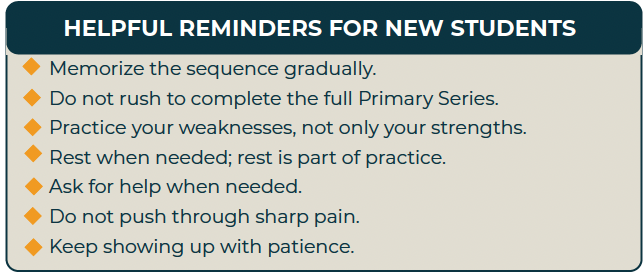
Learning the sequence is a little like learning a language: first you become familiar with the basic sounds and patterns, then short phrases, and over time longer forms begin to make sense. That often means starting with Surya Namaskar and standing postures, then gradually learning more of the Primary Series in a steady, manageable way.
-
There is no expectation that everyone will do every posture, practice every day, or move in the same way. Bodies, minds, energy levels, injuries, stress, and life circumstances all affect practice, and you are encouraged to respond to that with honesty as part of the yoga.
-
When first learning the Primary Series, many students find it helpful to practice around three times per week and build gradually from there. It is important not to overexert yourself and to take time building endurance. A shorter regular practice can be more beneficial than infrequent long efforts— 30 minutes three times a week is typically better than three hours once a week.
-
Consistency can be supportive, but rest is part of the practice too. It is not necessary or desirable to practice every day; taking a day or more of rest when needed is appropriate. Notice how practice, rest, nutrition, stress, and recovery affect both body and mind.
-
Because this space is largely self-practice, learning to listen inward is part of the work. We occasionally offer Mysore-style classes with a teacher because guidance can be helpful when something feels confusing or hard to navigate alone, especially while learning the sequence.
-
Sharp pain is always a signal to stop. If something feels wrong, pause, reduce intensity, modify, rest, or ask for support. Discomfort and effort can be part of practice, but pain that feels sharp, alarming, or destabilizing should always be respected.
-
It is traditional to begin practice in Samasthiti with the Ashtanga yoga mantra. It is offered as one way to guide consciousness to the higher principles of yoga — the Guru within, the jungle physician removing the poison of conditioned existence (stanza one), and as an acknowledgment of the lineage of teachers (stanza two) said to stem from Patanjali. During self-practice sessions, students may begin and end quietly in the way that feels most supportive. The mantras can be understood as invitations to settle attention and close with goodwill.